A new layer of data for mining decisions

Most mineralogical models rest on a small number of measured samples and a lot of estimates. S-XRD makes it practical to measure mineralogy at the scale of the entire orebody dataset.

01Typical current dataset

Chemical assaysMeasured
···
Mineralogical dataMeasured + estimated
···
Direct mineralogical measurements Estimated / proxy-derived mineralogy

Mineralogical models are often built on estimates.

02With DeterMin S-XRD

Chemical assaysMeasured
···
Quantitative mineralogyMeasured at scale
···
Campaigns from hundreds to tens of thousands of samples.

Mineralogy measured across the deposit. A stronger measured foundation for mineralogical models and decision-making.

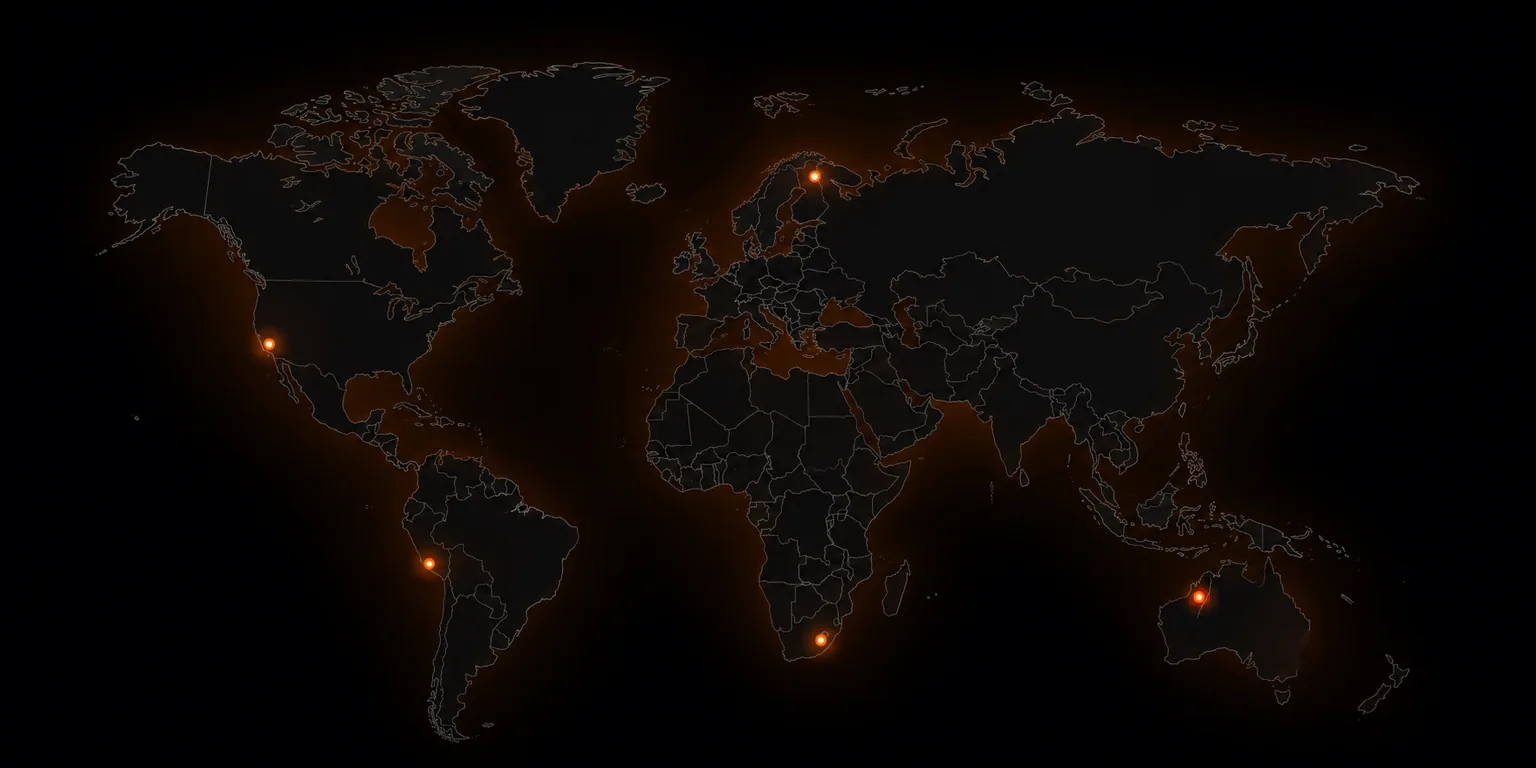
150,000+S-XRD samples analysed across five continents for several of the world’s largest mining companies

Dark world map with five glowing orange points marking locations in North America, South America, Europe, Africa, Australia.
Our vision

Our vision is to make quantitative mineralogy the backbone of decision-making across the mine, used at the same scale as chemical assays are today.

Why it matters?

Benefits for Mining Operations

Our technology makes large-scale mineralogical analysis possible with the precision, speed, scalability and cost efficiency needed for mining operations.When you know the mineralogy across the orebody, you can make better decisions in mine planning, investment and processing — and capture more value from the ore.

Technological advantage of S-XRD

Precision

More precise than conventional XRD

Speed

Fast turnaround even in large campaigns

Scalability

Campaign sizes from hundreds to tens of thousands

Cost efficiency

Price per sample comes down with scale

DeterMin mineralogical expertise

A large-scale mineralogical model of the orebody

Built to support decisions across the mining operation

Business impact

Better block models

When you know the mineralogy, you can build better block models and improve domaining, blending and ore routing.

Reduce investment risk

When you know the mineralogy, you can make better investment decisions in plant design, flowsheet changes, equipment selection and mine planning.

Improve processing performance

When you know the mineralogy, you can optimise blending, reagent use and process settings to improve recovery and reduce losses.

Better recovery, better investments, better mine planning.

What we do?

The journey from pulps to quantitative mineralogy

DeterMin creates mineralogical datasets from pulverized mining samples using synchrotron-based X-ray diffraction, at a scale conventional mineralogy cannot reach. Here is how a campaign runs.

From a few hundred samples to more than 50,000 in a single campaign.

Usually the same pulps already used for assay — no new sampling.

01
Input

Sample preparation

Once the samples are selected and gathered, each pulp is encapsulated for synchrotron measurement. Because no suitable capsule existed for this type of acquisition, we designed our own using an amorphous aerospace-grade plastic that produces exceptionally low background during measurement.

02
Measurement

Synchrotron data collection

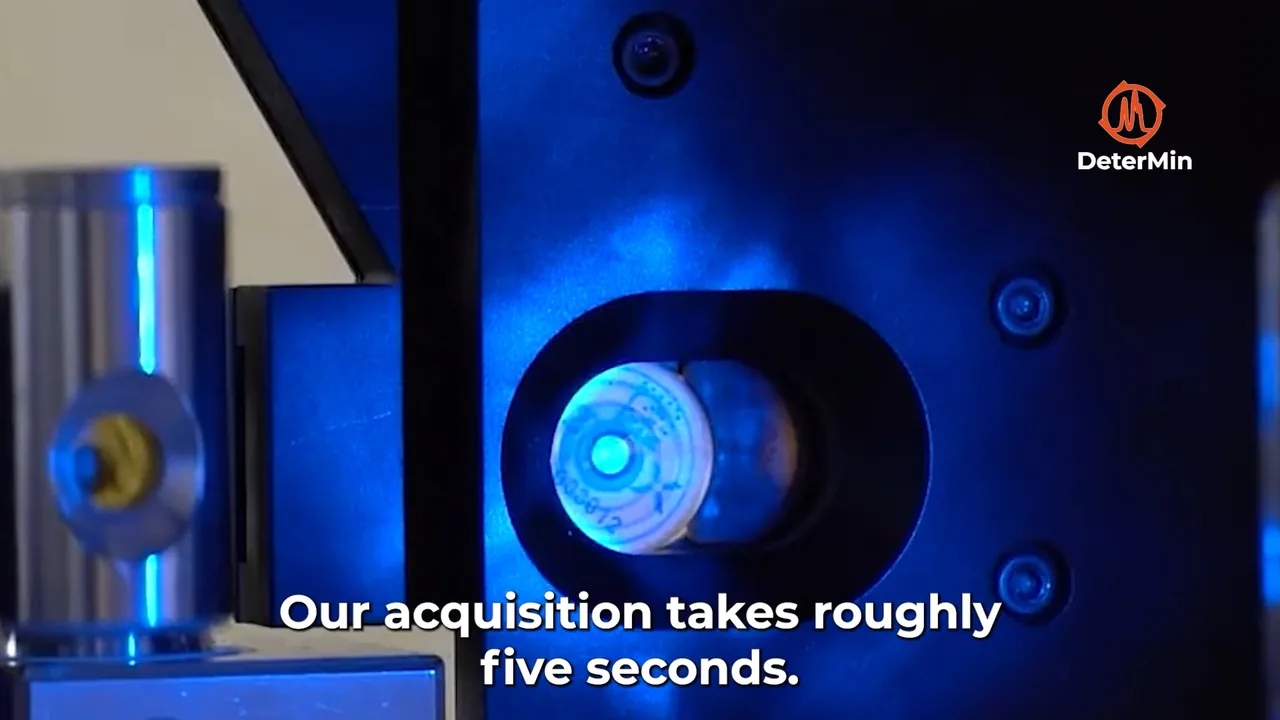
Data is collected at world-class synchrotron facilities in Europe. A monochromatic beam records each pattern in about five seconds. Assay pulps are ground for chemistry rather than diffraction, so the capsule is shaken vigorously throughout the acquisition — constantly bringing new crystallites and orientations into the beam, and summing a diffracting volume far beyond what a laboratory instrument can reach.

03
Ore-specific Rietveld model — built once

Building the mineralogical model

Mineral phases are identified from the collected patterns, and the most representative sample of each mineral becomes a building block of an automatic Rietveld refinement model built for your deposit.

The reliability of the quantitative results depends on the completeness of the mineralogical model. This is where the synchrotron gives us a major advantage: we are able to analyse a very large and representative sample set when building the model. The more geological variation we capture across the deposit, the more reliable the model becomes. We build this model once for the deposit, and after that, new campaigns can be analysed at any scale.

04
Output

Results for every sample

Each capsule is analysed against the refinement model and turns into quantitative mineralogy. Results include percentual mineral phase composition and back-calculated chemical composition. Where needed, the amorphous component can also be quantified using internal standardization. Tens of thousands of samples in a single campaign, at a price per sample in a class of its own — a mineralogical data layer that sits next to your chemical assays.

Determin video
Watch: DeterMin CEO Jarkko Stenman explains S-XRD acquisition time
Tell us what you need to measure

Why Determin

How We Achieve Higher Precision

Two factors drive the precision, and the second depends on the first: a high-flux synchrotron beam that reveals mineral phases conventional laboratory XRD may miss, and enough measurements to build a Rietveld model around the minerals actually present in the ore.

01

The beam

Higher photon flux & Monochromatic beam

The beamline at the Synchrotron delivers around 1×10¹² photons per second. A molybdenum-anode laboratory tube delivers around 5×10⁷. One second in the beam gives us the photons a lab instrument produces in 55.5 hours.

But flux is only part of the advantage. The synchrotron beam is monochromatic, avoiding Kα₁/Kα₂ peak splitting, while our transmission setup continuously brings fresh crystallites into the beam. Together, these features improve peak definition, counting statistics and sensitivity, enabling more reliable quantification of minor phases.

02

The mineralogical model

An ore-specific Rietveld model

This is where scale improves accuracy. By measuring thousands of samples from the same deposit, we build a much more complete picture of its mineralogy, including minor and rare phases that smaller datasets can easily miss.

That complete mineral inventory becomes the basis of the Rietveld model used across the entire sample set. The result is more reliable quantification, because the model reflects what is actually present in the ore rather than forcing an incomplete set of minerals to explain the diffraction pattern. For a mine, that means better mineralogical data behind decisions in geology, processing and resource modelling.

Working with us

Questions we get asked

What do you need from us to get started?
What are the requirements for the pulp?
How much sample do you need?
How long does it take?
What do we receive at the end?
How do we know the results are right?
Can you quantify amorphous content?
Talk to us about your deposit

Something not answered here? Ask us directly.

About us

Our story

Built by a geologist whose determination to understand minerals led him to synchrotron science.

DeterMin is built around Jarkko Stenman, a geologist and mineralogist who graduated from the University of Helsinki. He has been collecting minerals since the age of four, and fittingly, his surname means “stone man” in Swedish.

In 2017, a Finnish mine asked him a simple but difficult question: what is actually in 54,000 drill-core pulps sitting in storage? With conventional laboratory XRD, analysing that volume would have taken years. Jarkko took the samples to a synchrotron and measured them in just seven days.

But the seven-day measurement was only the beginning.

It proved that XRD could be scaled to tens of thousands of samples. Turning that experiment into a reliable analytical method took years of further development. The team refined the measurement workflow at the beamline, developed ways to process and manage the enormous volumes of diffraction data, and built the mineralogical modelling and Rietveld workflows needed to analyse thousands of samples consistently and quantitatively.

Alongside this, they developed the sample preparation, automation and analytical methods required to make the entire process work as one scalable system.

The services DeterMin provides today are built on that work: combining industrial-scale synchrotron measurements, large-scale data processing and mineralogical expertise to deliver consistent, sample-specific quantitative mineralogy across large sample campaigns.
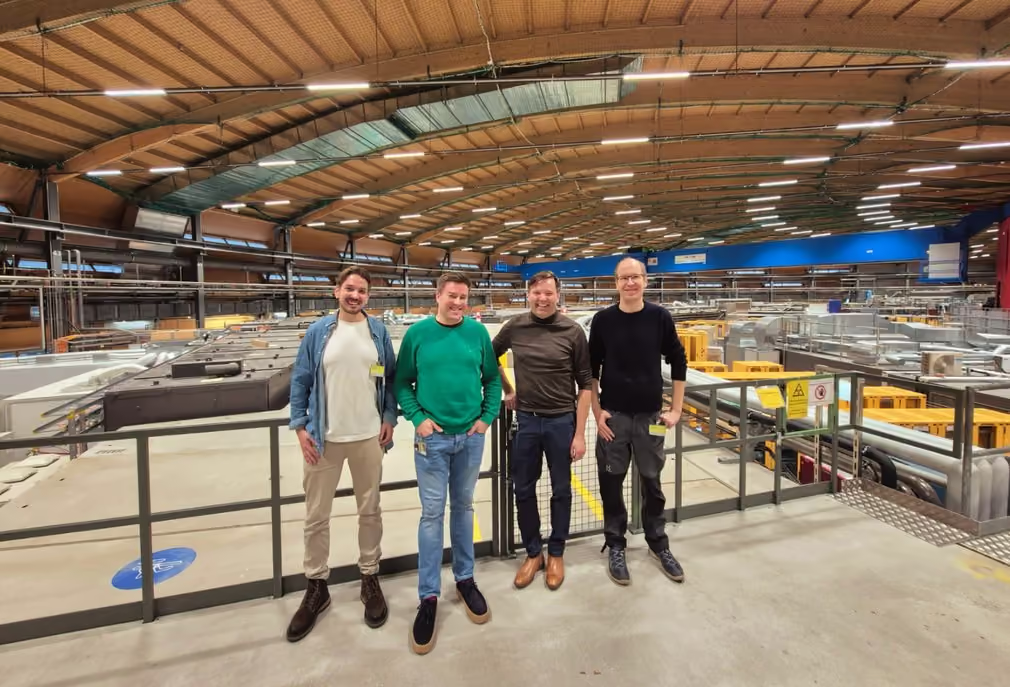
The four founders of Determin at the synchrotron — from left, Joonas Pajunen, Jarkko Stenman, Eljas Vesterbacka and Vesa Solonen

The four founders, at the synchrotron. From left: Joonas Pajunen, Jarkko Stenman, Eljas Vesterbacka, Vesa Solonen.

Our team

JP

Commercial

Joonas Pajunen

COO · Operations & Sales

Commercial operations, client projects and contracting.

Email: firstname.lastname (a) determin.fi

First contact for quotes and new projects.

JS

Analytical

Jarkko Stenman

CEO · Head of Mineralogy

Geologist and mineralogist with decades of expertise in quantitative XRD and Rietveld refinement.

Email: firstname.lastname (a) determin.fi

ER

Analytical

Emma Rauhala

Data Analyst

Research in machine learning and neural networks for quantitative phase analysis and Rietveld refinement.

VS

Sample prep & lab

Vesa Solonen

Sample Preparation Lead · Data handling

Sample preparation methodology, data handling and R&D.

IJ

Sample prep & lab

Ilkka Juvonen

Laboratory

Sample encapsulation and laboratory logistics.

EV

Board

Eljas Vesterbacka

Chairman of the Board · Finances

Start a conversation

Interested in better mineralogical data from your ore?

Want to explore what synchrotron-based XRD could add to your mineralogical data? Get in touch to discuss the possibilities.

That went through faster than a person usually types. Please check your details and press Send again.

We reply within two working days. Nothing you send is shared outside DeterMin.

Thank you — your message is with us. We come back to you within two working days.

That did not go through. Please try again, or use the contact details in the team section above.